The future workplace, designed right
By Phil Sunderland, Basecamp Leader of Rmkble's JourneyOne team.
Abstract
The concept of the “Future Workplace” is no longer abstract or futuristic — it’s pressing and present. As AI and emerging technologies become increasingly accessible, organisations must urgently rethink the human side of transformation.
At JourneyOne, we’re seeing clear signals: capability uplift is now critical, not optional. This article explores the people, skills, and cultural shifts required to thrive in an AI-enabled world — and how a simple but powerful model is helping organisations assess, prioritise, and activate change across all levels of their workforce.
The future is no longer a concept, it’s the condition we’re in
“Future Workplace” has been a buzzword for years, often used to signal what’s coming next, or what we should prepare for someday. But for most organisations today, the “future” is already knocking loudly at the door. Mary Meeker’s 2025 report on Trends in AI underscores that AI's evolution is "ramping materially faster" than previous tech waves.
The rapid emergence of highly available, low-barrier technology means transformation is not something we’re planning for, it’s something we’re already in. At JourneyOne, what we’re seeing on the ground is clear: there is a critical need to build new capabilities across the workplace, where humans, technology, and operating models come together to enable organisations to thrive.
Work is being rewritten, and so are the people doing it
The way we work, the way we collaborate with technology, and the capabilities we rely on as humans are all in motion. AI isn’t just a tool, it’s reshaping the very nature of roles, decisions, and workflows.
Global research echoes this shift:
75 million jobs may be displaced by changes in the division of labour between humans and machines — while 133 million new roles may emerge. (World Economic Forum, Future of Jobs, 2025)
By 2030, one billion people will need to reskill as jobs evolve alongside machines and algorithms. (World Economic Forum)
But our insight goes deeper: transformation isn’t just happening in pockets, it’s happening across the full spectrum of the workforce. We’re working with boards and executives grappling with strategic direction and risk, and simultaneously supporting frontline teams overwhelmed by inefficiency, rework, and unclear expectations.
A capability-first response to an AI-enabled world
As a consultancy, we see our role as guiding organisations forward with clarity and confidence. That’s why we’ve invested in research to understand what kinds of human and hybrid capabilities will be essential for success in the next wave of transformation.
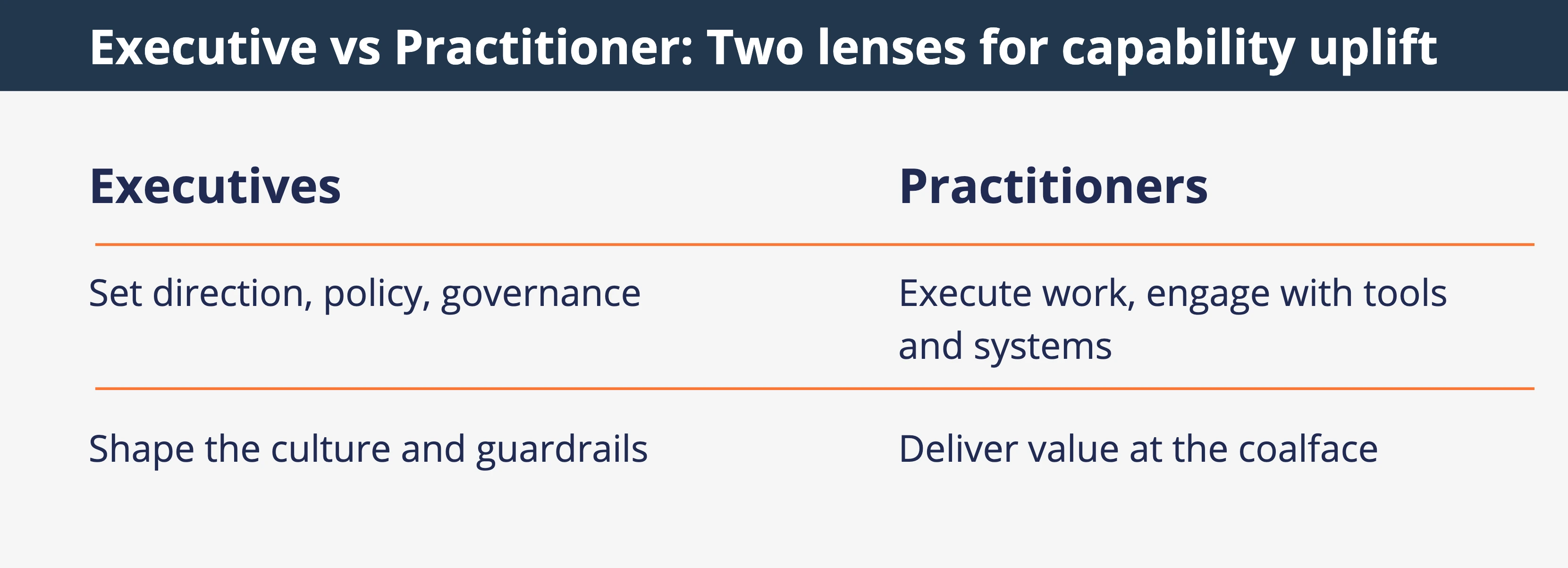
Through a human–technology collaboration lens, we’ve identified 42 capabilities that enable people to thrive in an AI-enabled world. These range from cognitive and interpersonal skills to digital fluency, adaptability, and ethical judgement. Additionally, the AWS Generative AI Adoption Index (2025) found 45% of IT decision-makers are prioritising GenAI over security, and workforce upskilling is now a top agenda item.
To make these more accessible, we’ve grouped them into nine capability areas that span three key domains:
- Human – our cognitive, emotional, and ethical skills
- Ways of Working – how we think, collaborate, and lead
- Technology – fluency, exploration, and integration
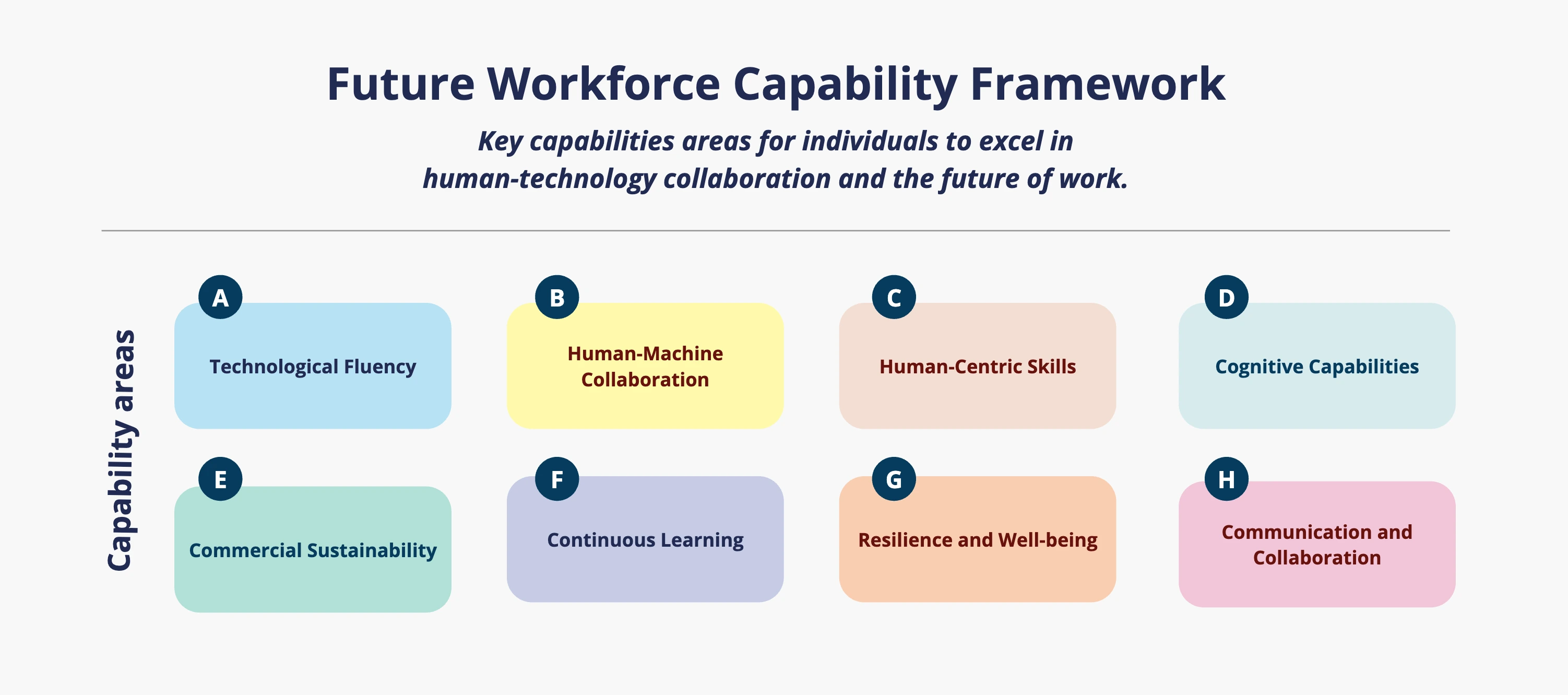
Executive vs Practitioner: Two lenses for capability uplift
One of the most effective ways we’ve found to prioritise capability building is to look at the workforce through two essential lenses:
- Executives – those that set the direction, the guardrails and governance
- Practitioners – those that execute within your workforce
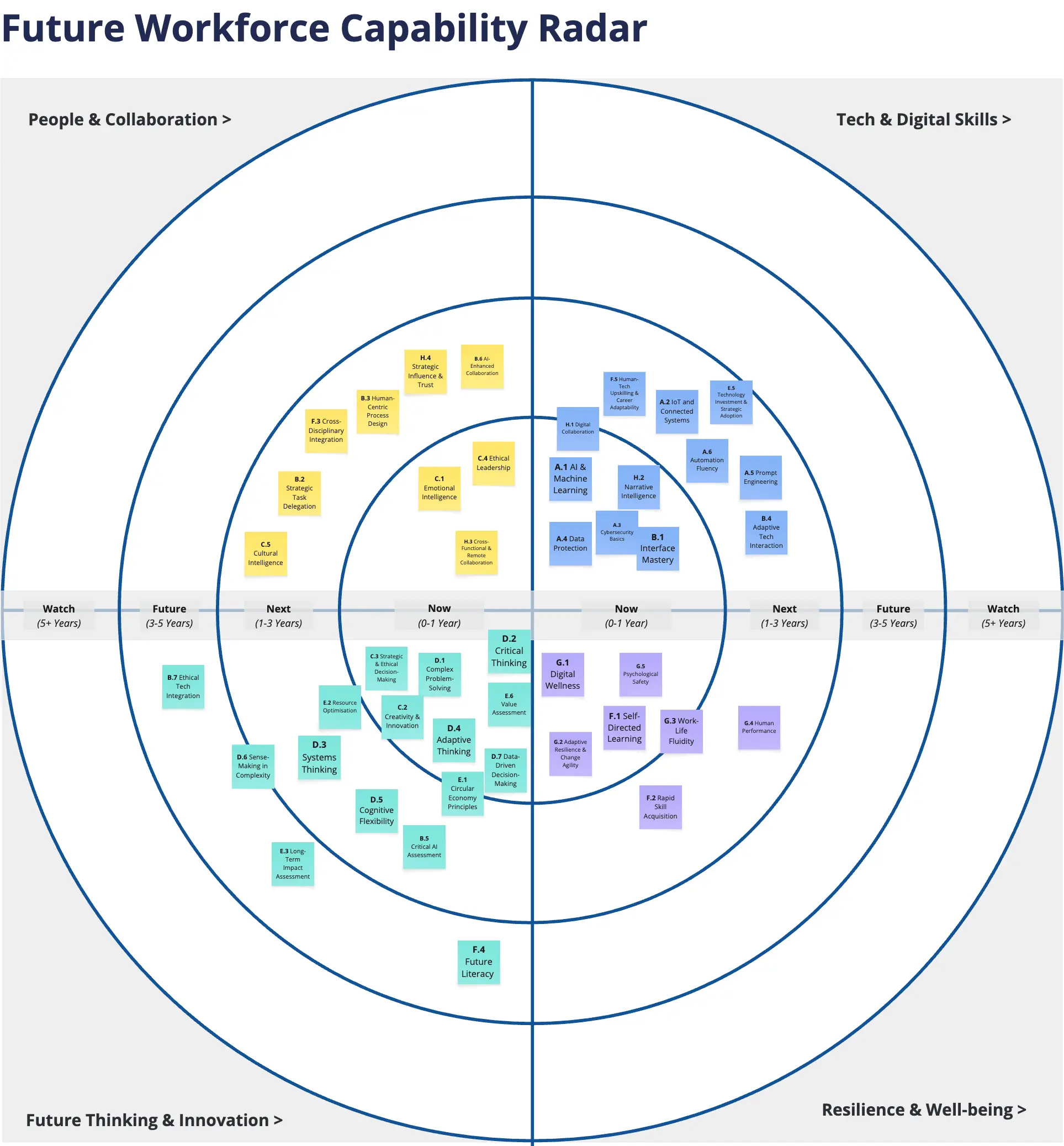
When we started mapping the most applicable, valuable, and non-negotiable capabilities, it quickly became clear that something simple, but powerful, was needed to navigate them. That’s why we created the Capability Radar: a tool that helps organisations plot what matters most now, while still seeing what’s next and what can wait.
What executives need now
When we apply the executive lens, four capabilities emerge as top priorities. These are not new, but their application in the current context is more critical than ever:
- Strategic task delegation (human–machine collaboration)
- Critical thinking (cognitive)
- Strategic and ethical decision-making (human-centric)
- Adaptive resilience and change ability (human-centric)
While most leaders possess these skills on paper, the challenge lies in how they’re now being exercised. In the AI era, strategic task delegation isn’t just about resource allocation; it’s about knowing when to involve machines, and when to lean on human judgement.
This is evidenced through the work we’re doing as part of our JourneyOne's Responsible AI product, a focused offering designed to help organisations navigate policy, ethical use, and data privacy in an AI-enabled world.
What practitioners need to thrive
On the ground, Practitioner capabilities look different, but are no less critical. These capabilities enable teams to adapt to new tools, ways of working, and expectations:
- Technology fluency and rapid learning
- Critical sense-making
- Empathetic collaboration and psychological safety
- Adaptive resilience and change ability
In our testing, we’ve found that uplift doesn’t mean turning everyone into AI experts overnight. It starts with awareness and foundational understanding. From there, organisations can experiment, test, and grow.
Capability uplift isn’t a program, it’s a mindset
Our testing shows that organisations don’t need to go from zero to expert in every capability overnight. It starts with awareness and foundational understanding. From there, we support clients to self-assess, identify priority gaps, and build a pathway forward through testing and learning.
Our focus is on enabling real progress, helping teams and leaders develop the confidence, adaptability, and practical capability to thrive in a human-led, technology-enabled world.
As Heather E. McGowan, a leading expert in Future Workforce readiness, says, “The most important skill any individual can possess today is the ability to learn, unlearn, and relearn.”
Is your workforce ready for what’s already here?
We work with organisations to assess, prioritise, and build the capabilities that enable human–technology collaboration at scale. Whether you’re shaping policy in the boardroom or adapting systems at the coalface, we can help you move forward with confidence.
Let’s build a workforce fit for the future.




Let's create positive change for your organisation
If you’re ready to discuss your goals, reach out to us via the form and one of our team members will be in contact with you. Alternatively, drop us a query or an expression of interest at: operations@rmkble.com.au.