
Delivery that builds confidence
By Phil Sunderland, Basecamp Leader of Rmkble's JourneyOne team.
Abstract
Across industries, we’re seeing a new pattern emerge: effective delivery now begins ahead of strategy. In a fast-evolving landscape shaped by AI and automation, early education, use case exploration, and governance alignment are essential to build confidence and mitigate risk.
In our work with clients across healthcare, financial services, and resources, we’ve seen that delivery is no longer linear. It’s iterative, learning-driven, and human-first. Two speeds of delivery are emerging: one for immediate productivity, and another for deep transformation. Both are essential. Together, they shape not just how we deliver value — but how we shape the future of work.
Early delivery creates strategic clarity
“Vision to value” has long been the mantra for how we work at JourneyOne. It reflects our belief in delivering meaningful progress through iterative, value-led delivery.
With the accelerating pace of change, in both technology and human capability, we're seeing a new way of navigating between vision and value — one that calls for a deeper shift in how strategy, delivery, and learning connect.
There is a clear new pattern: delivery must now move ahead of strategy. It’s no longer enough to set a long-term vision and then move to execution. The technologies are too new, the implications too complex, and the stakes for people and organisations too high.
Early action is essential, not just to prove feasibility but to build understanding, confidence, and alignment.
The AWS Generative AI Adoption Index (2024) highlights that organisations piloting or scaling GenAI are significantly more likely to report having a clear vision for how to use it across their business. This reinforces that early experimentation helps accelerate alignment between technology and strategy.
Before we can set a strategy with confidence, we need to experiment, educate, and explore.
Governance must enable, not block, innovation
Concerns around data privacy, ethical risk, and psychological safety are real. For many of our clients, governance has become the first place to start, not to control innovation, but to enable it.
At a large resources company, we’re helping teams update governance frameworks through the lens of AI. That means aligning with current and emerging standards (including NIST and Australia’s AI Ethics Principles), while also making space for experimentation.
It starts with education, then policy, then integration, ensuring guardrails protect both people and innovation.
AI governance is increasingly seen not just as a compliance obligation, but as a strategic enabler of safe experimentation and innovation. Across industries, there’s a growing trend toward governance frameworks that not only safeguard AI systems, but also support iterative learning, agility, and responsible scaling. Forward-looking organisations are evolving their policies to enable ethical, secure adoption — creating space to explore AI’s potential while managing risk.
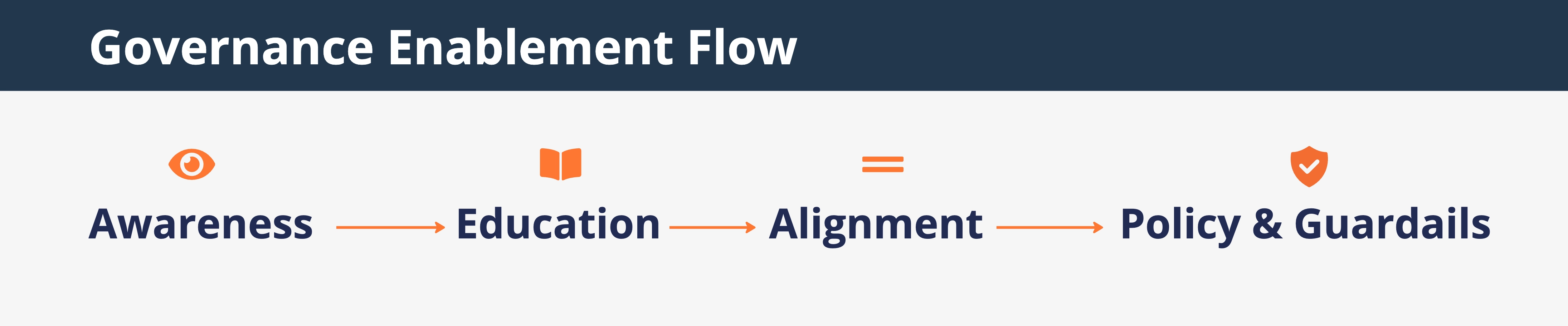
Governance isn’t just about risk, it’s about readiness and enabling safety for innovation.
Delivery is a loop, not a line
Delivery in the human-technology collaboration era isn’t linear. It’s an ongoing feedback loop, where new capabilities, workforce impact, and emerging features continuously feed back into strategy, investment, and change.
At a major financial services organisation, our foundational awareness sessions for executives evolved into an embedded leadership capability program. These sessions don’t just inform, they shape future decisions. Leaders are learning how to assess AI opportunities, weigh impacts, and lead with confidence in complexity.
This loop is critical:
- What impact will this technology have on people?
- How ready is the workforce?
- What new capabilities are required to thrive?
Delivery is no longer linear — it’s a loop of learning, alignment, and iteration.
Two speeds of delivery, both essential
To deliver well, organisations must operate at two speeds:
- Fast-track delivery for immediate value, productivity gains from automation, low-level task removal, or enterprise tool rollouts
- Strategic delivery for long-term reinvention, transformative prototypes, process redesign, or new business models
At one natural resources client, we helped implement this continuum: deploying enterprise tools to unlock short-term efficiency while simultaneously exploring bold prototypes to redefine business value.
Think of it as a value arc:
- Initial 10–20% gain through automation and tools
- Time and insight freed for deeper strategic change
- Readiness built for transformation at scale
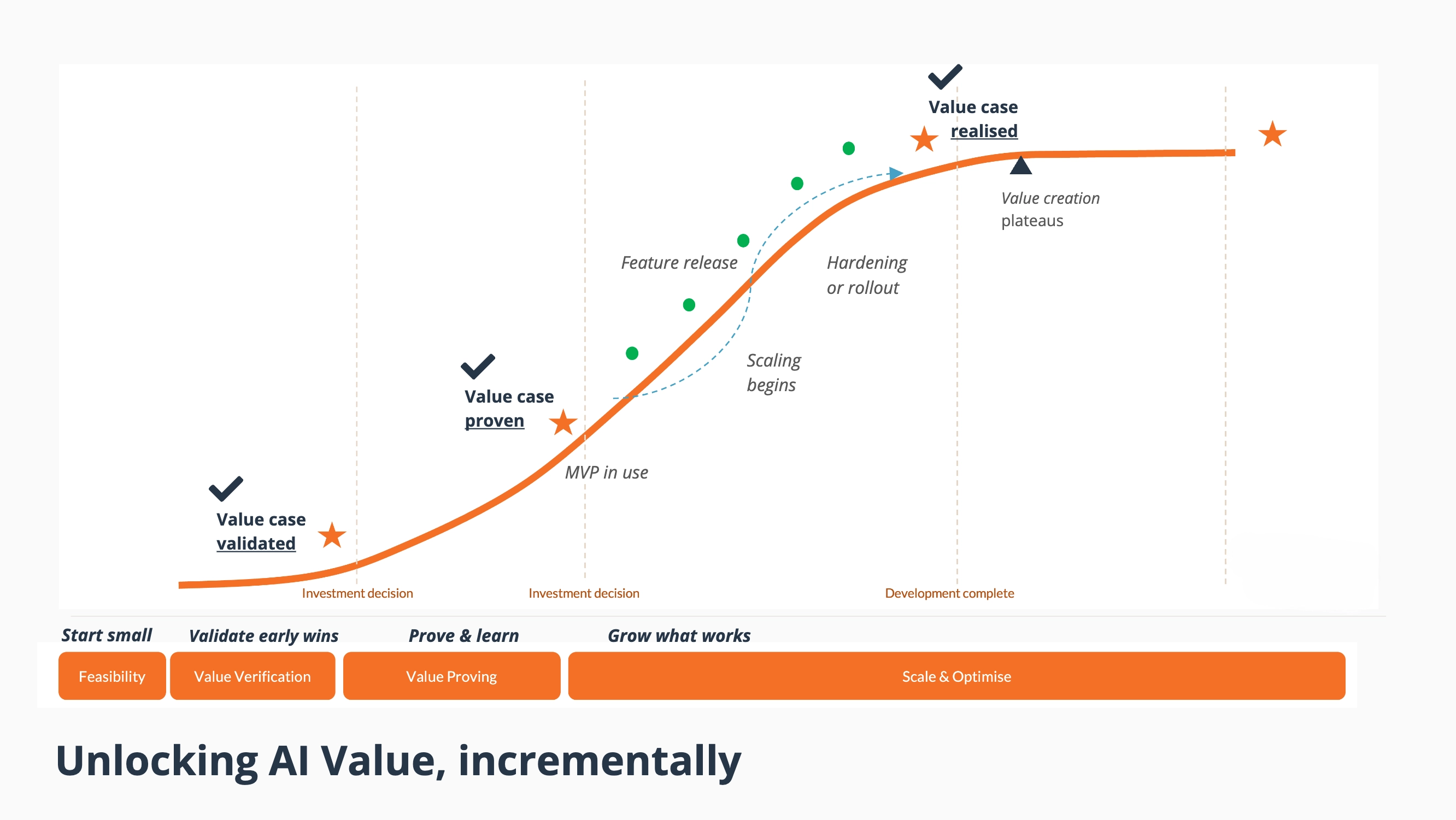
A 2025 PwC study reinforces this model, identifying dual-speed transformation as a hallmark of successful AI adoption. It highlights that organisations making 'big leaps' through strategic reinvention while simultaneously pursuing incremental, tactical gains are best positioned to scale impact and drive lasting transformation.
The mindset shift in modern delivery
Governance isn’t just about risk, it’s about readiness and enabling safety for innovation. Delivery is no longer linear — it’s a loop of learning, alignment, and iteration. Ultimately, what we see time and time again at JourneyOne is that great delivery doesn’t just implement strategy, it shapes it.
The World Economic Forum's Future of Jobs Report 2025 affirms this looped approach, noting that continuous reskilling and agile adaptation are now top organisational priorities. In fact, 75% of companies surveyed plan to upskill at least 10% of their workforce in response to AI, highlighting the urgent need for iterative, capability-informed strategy cycles.
Delivery in human-technology collaboration isn’t just execution, it’s how organisations build confidence, surface insights, and learn fast enough to lead through change.
Before we can set a strategy with confidence, we need to experiment, educate, and explore
We help organisations activate early, testing emerging technology, building executive confidence, and uncovering capability needs before strategy is finalised.
Start before you are ready
Ready to shape smarter delivery?
We work with organisations to turn early proof into long-term progress. Whether you're testing viability, adapting governance, or building capability, we can help you shape a delivery path that accelerates confidence and keeps pace with transformation.





Let's create positive change for your organisation
If you’re ready to discuss your goals, reach out to us via the form and one of our team members will be in contact with you. Alternatively, drop us a query or an expression of interest at: operations@rmkble.com.au.